A second period English lantern clock by Peter Closon, London. Circa 1650.
A good example of a clock by this eminent maker.
Stock No: 14530
The short duration, separately wound wheel trains with tapered and un-colleted arbors and large pinions. Now having a long pendulum, Anchor Recoil escapement and the wheel trains are mounted in the usual way in 3 upright narrow plates. Countwheel striking the hours with a large hammer head within the top-mounted, cast bell.
The dial plate is engraved with a floral design with a blank area containing the maker's name of "Peter Closon Near Holborn Bridge Fecit" curving under the upper chapter ring. The chapter ring has 2 outer rings, short Roman hour numerals, wheat stalk half hour marks and an inner, divided quarter track. The blackened iron hand is well executed.
The pillared frame has typical turned urn finials and small ball feet. The bell is hung from a cross carrier that is sprung within the finials. All 3 'Dolphin' style frets are engraved which is unusual. The movement is substantial and well constructed.
* Peter Closon was born about 1595 and was apprenticed to Henry Stevens in 1608 for 8 years. He is considered a very famous maker and is well documented. It is believed that he died in 1660.
** This clock is almost identical to a clock by him (even down to the dimensions), that is now in the British Museum and is featured in the book 'Early English Clocks' by Dawson and Parker, page 64. This really is a lovely example of a lantern clock by a superb maker.
Please note: Though the hoop and spikes are missing, the movement can be placed on
one of our handmade lantern clock brackets, this is also much gentler on the
clock as it removes all angular strain. The brackets are made from period
English oak and are constructed without nails or screws. Please click this link.
Dimensions: 14" high (to the top of the broken finial) x 5 3/4" wide x 5 3/4" deep (plates size).
Circa: 1650.
Condition: The movement is dusty, dry and shows signs of considerable wear. The balance
wheel escapement has been converted and to allow this, the whole alarum work
has been removed, including the disc. The escapement however is almost
experimental in appearance suggesting that it was made at the very beginning
period (1657), of the newly invented escapement.
The doors and iron backplate are missing also the weights. The bell carrier has
been poorly repaired and along with the top finial, is not original. The hanging
'hoop' and spikes are also missing. It is believed that 99% of lantern clocks have
fallen from the wall at least once in their lifetime. This is the reason why so many
of them have damaged or missing parts; they are heavy and landing upon a hard
floor would without doubt, cause at least some damage.
Price: £10,000 in its present condition. We can of course, rectify all issues with these
clocks and would be happy to discuss any requirements upon contact.


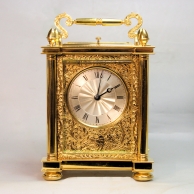
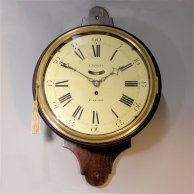
A 'Salt box' verge escapement, fusee, English dial wall clock by Upjohn of Exeter. Circa 1790.
View Details