1st Period English lantern, house or chamber clock. Circa 1620.
An attractive example of a very early Lantern clock.
Stock No: 14531
The originally of short duration, rope driven, two train separately wound movement with Verge escapement and rare, front-mounted, short 'cow tail' pendulum. Countwheel striking the hours on the top-mounted bell that is square pegged and underslung from the crossed carrier that is sprung within the finials. The front and rear mounted wheel trains are pivoted within the usual 3, upright, flat pillars that are located and wedge-fitted between the square top and bottom plates. The movement also has alarum work that is fitted to the outside of the iron backplate and the pallet arbor front rolls on a 'knife edge' and has a decorative pendulum rod top.
The 4 tapered corner pillars terminate in early and large urn finials and shaped feet and the pin-hinged side doors have early crown style knobs.
The dial plate is profusely and beautifully engraved with a tulip design as are the corners. The centre carries the 4 tabbed alarum setting disc that has Roman hour numerals and a central open tulip flower. The cut iron hand is tailed to set and position the alarum set-off. The 3 top frets are of armorial design (English civil war period) and the front fret is nicely engraved with the shield bearing the date "1649" (the exact year that King Charles I was executed). The 6 3/8" diameter chapter ring has 2 outer circles, broad and short Roman hour numerals around a divided quarter track also, an inner circle that is dotted at the hours and 'wheat stalk' half hour marks. The decorative yet substantial bell strap has a large, central urn finial.
This is an extremely rare clock that is over 400 years old and it warrants the label "Historically important". 'Cow tail pendulums' are almost never seen on English clocks. The maintenance and updating of this clock are reflected in its very attractive price.
Dimensions: 15 1/2" high x 5 7/8" wide x 5 7/8" deep at the top and bottom plates.
Circa: 1620.
Condition: The movement is dusty and dirty but in working condition. It has historically
been fully maintained and shows very little signs of wear. The winding
sprockets have been adapted for longer duration and have the Huygens
'endless cord' method of winding. The escapement has been converted from
balance wheel. The alarum work appears to have been re-instated in the Dutch
style. The frets are replacements the front of which would have carried the
maker's name; the change was probably due to the owners being Loyalists and
in silent protest to the execution of the king (dated on the front fret). The doors
have been repaired because the tabs have been broken off (usually caused by
falling from the wall). The hanging hoop is a replacement and the spikes have
broken away from the iron backplate and are missing also, the rope holes in
the bottom plate have been elongated to allow the rope to run on different
diameter sprockets. The lower plate also has a small square hole to the right
side which I cannot explain. The clock shows obvious signs of damage from a
fall (as do 99% of lantern clocks) but is running beautifully upon one of our
handmade oak wall brackets; please click this link.
Price: £12,500 in its present condition. We are able to carry out corrective work to
these clocks and would be happy to discuss any requirements upon contact.


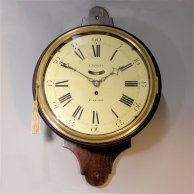
A 'Salt box' verge escapement, fusee, English dial wall clock by Upjohn of Exeter. Circa 1790.
View Details