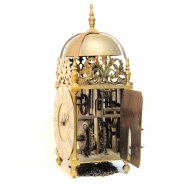
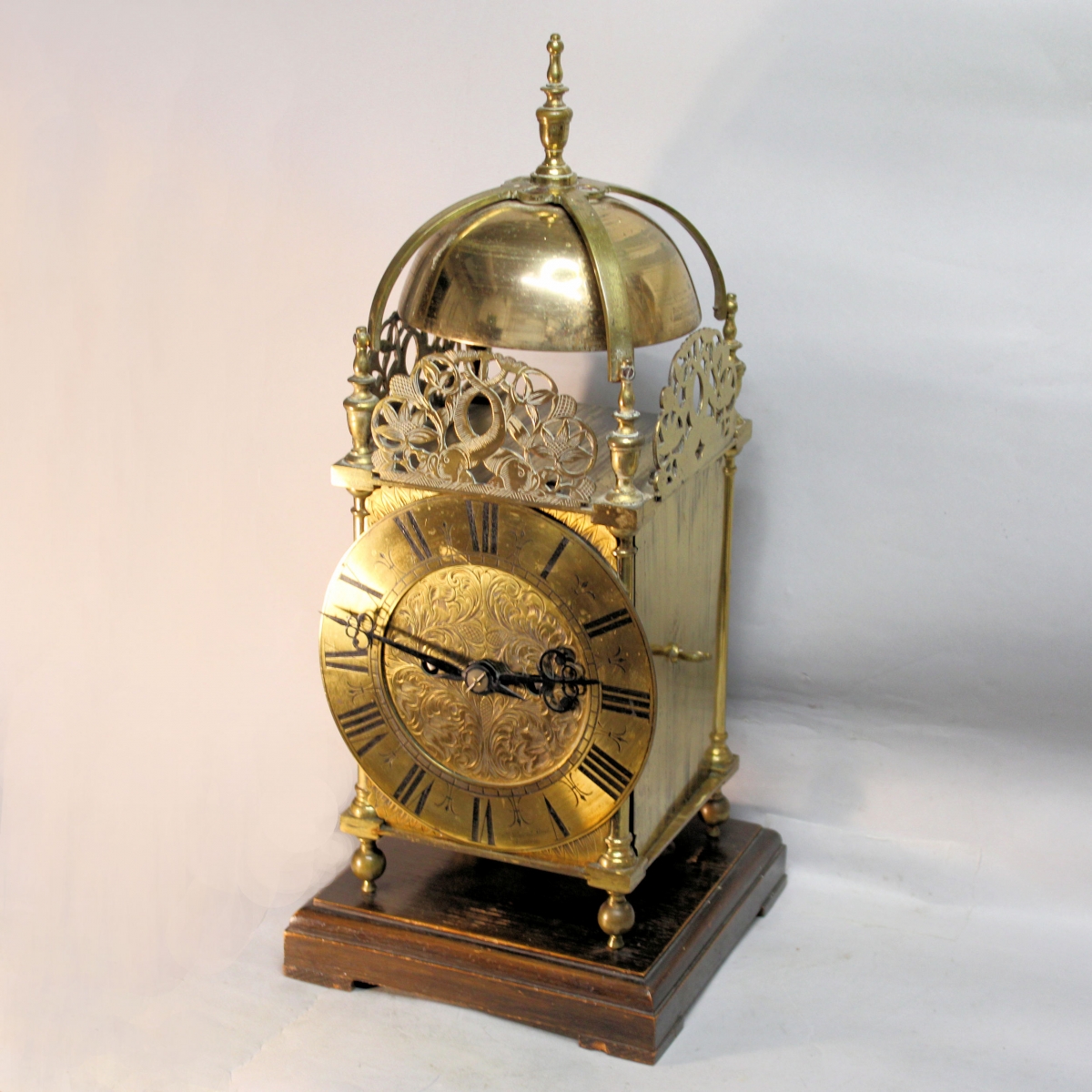
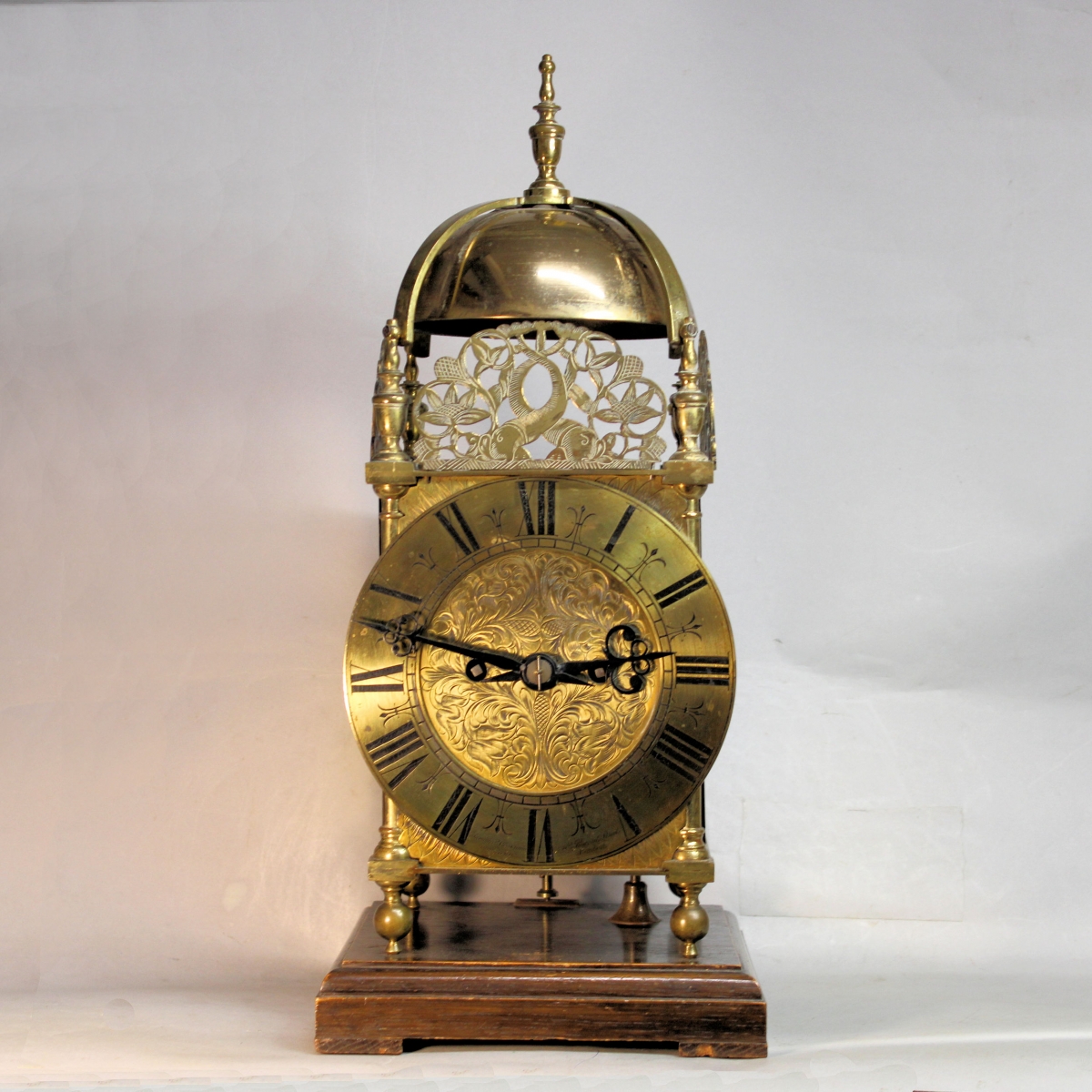
English fusee lantern clock retailed by the Goldsmiths & Silversmiths Company. Circa 1890.
Purpose made, high quality, striking table clock of an iconic style.
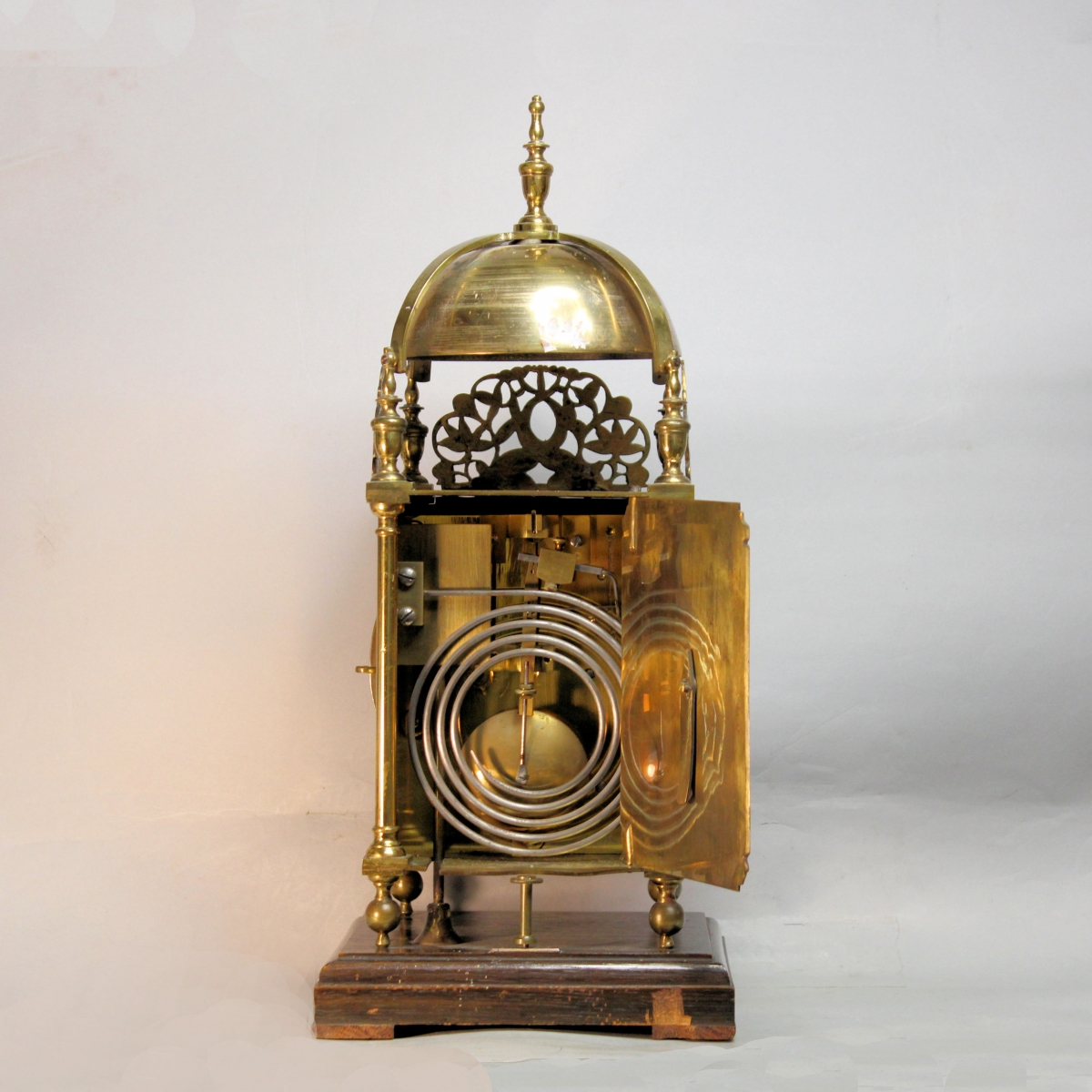
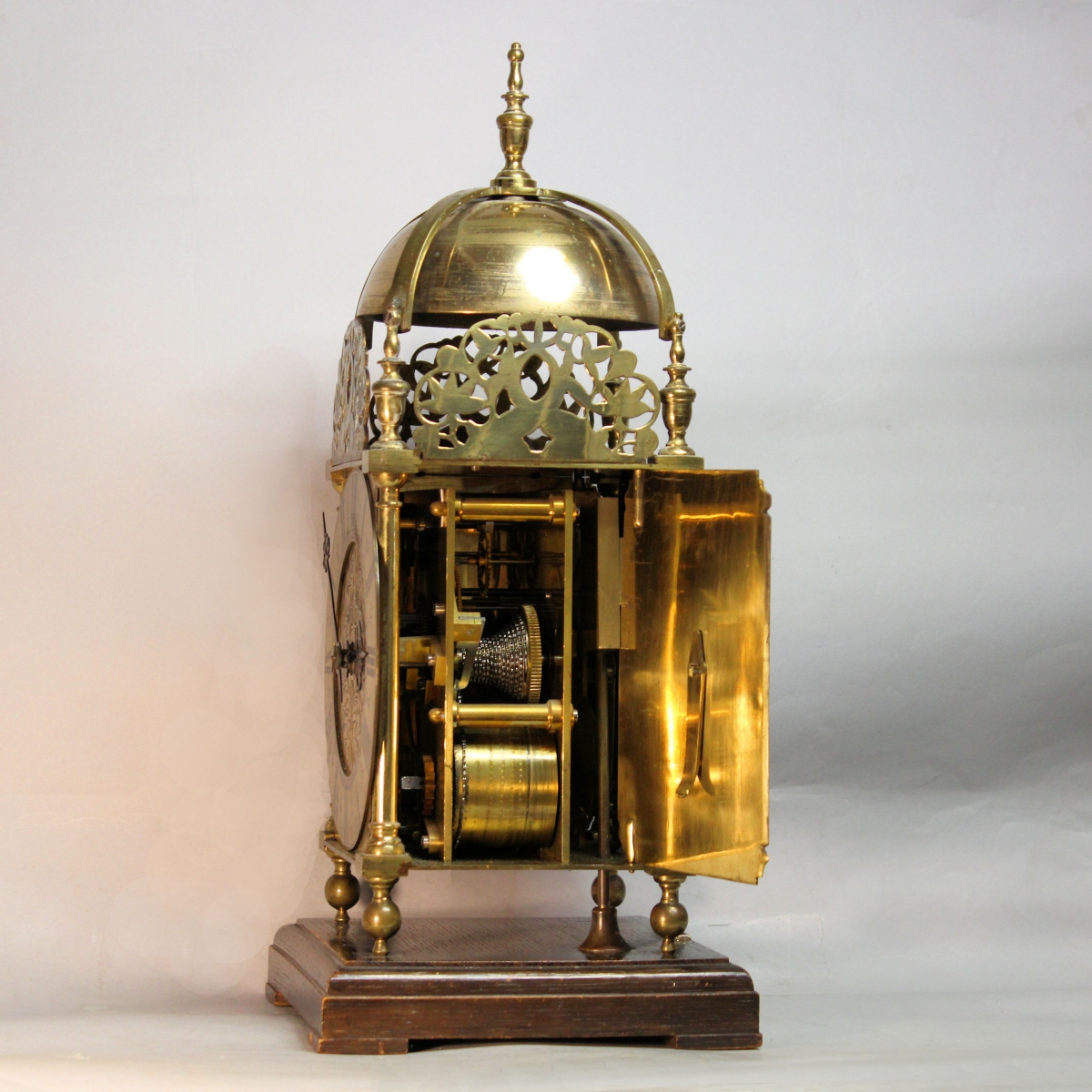
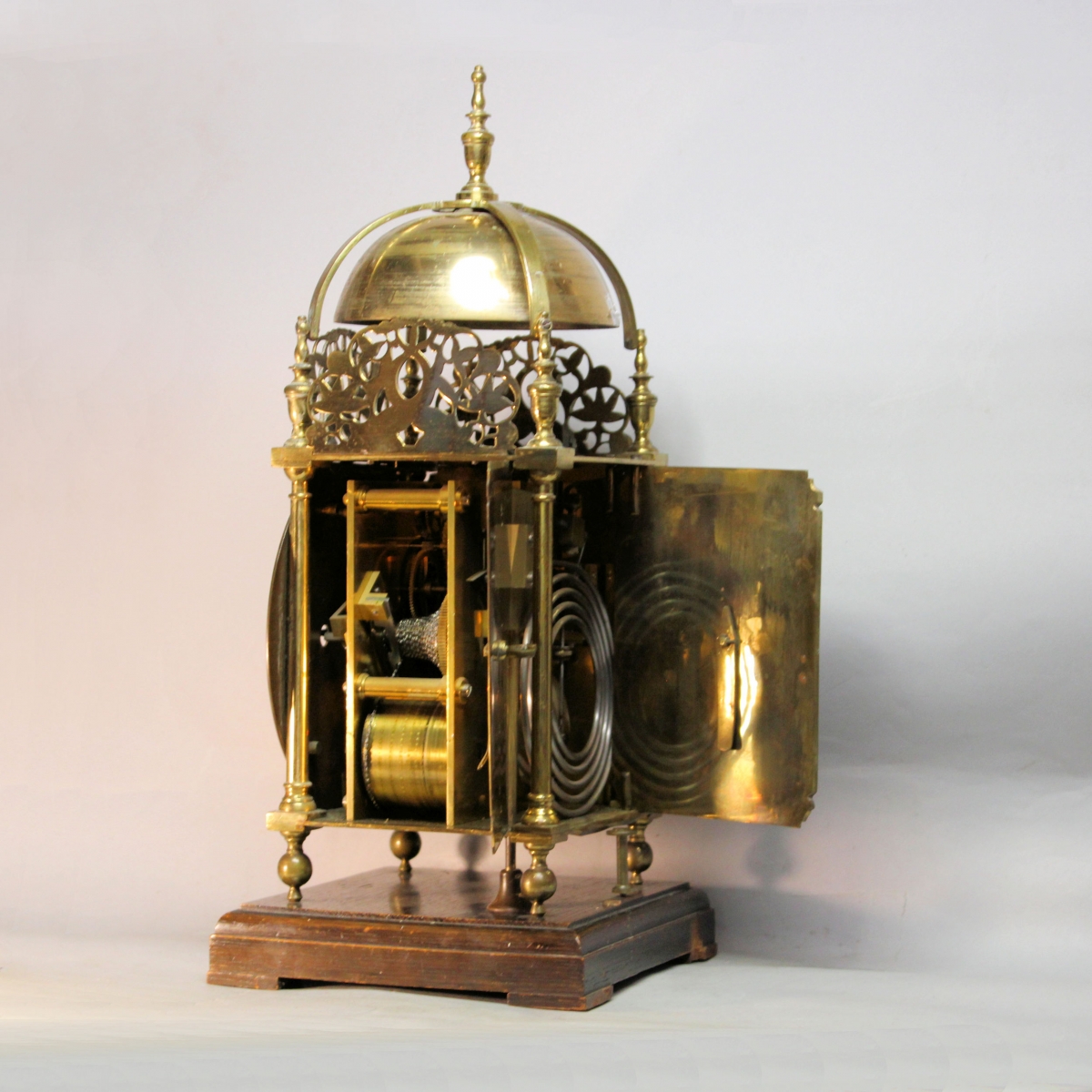
The very substantial, double chain fusee, 5 pillar movement with Anchor Recoil escapement and rack striking the hours and halfs on a large coiled gong that is within the case and mounted on the oak base. Also having micrometer regulation to the pendulum and a securing block for transit.
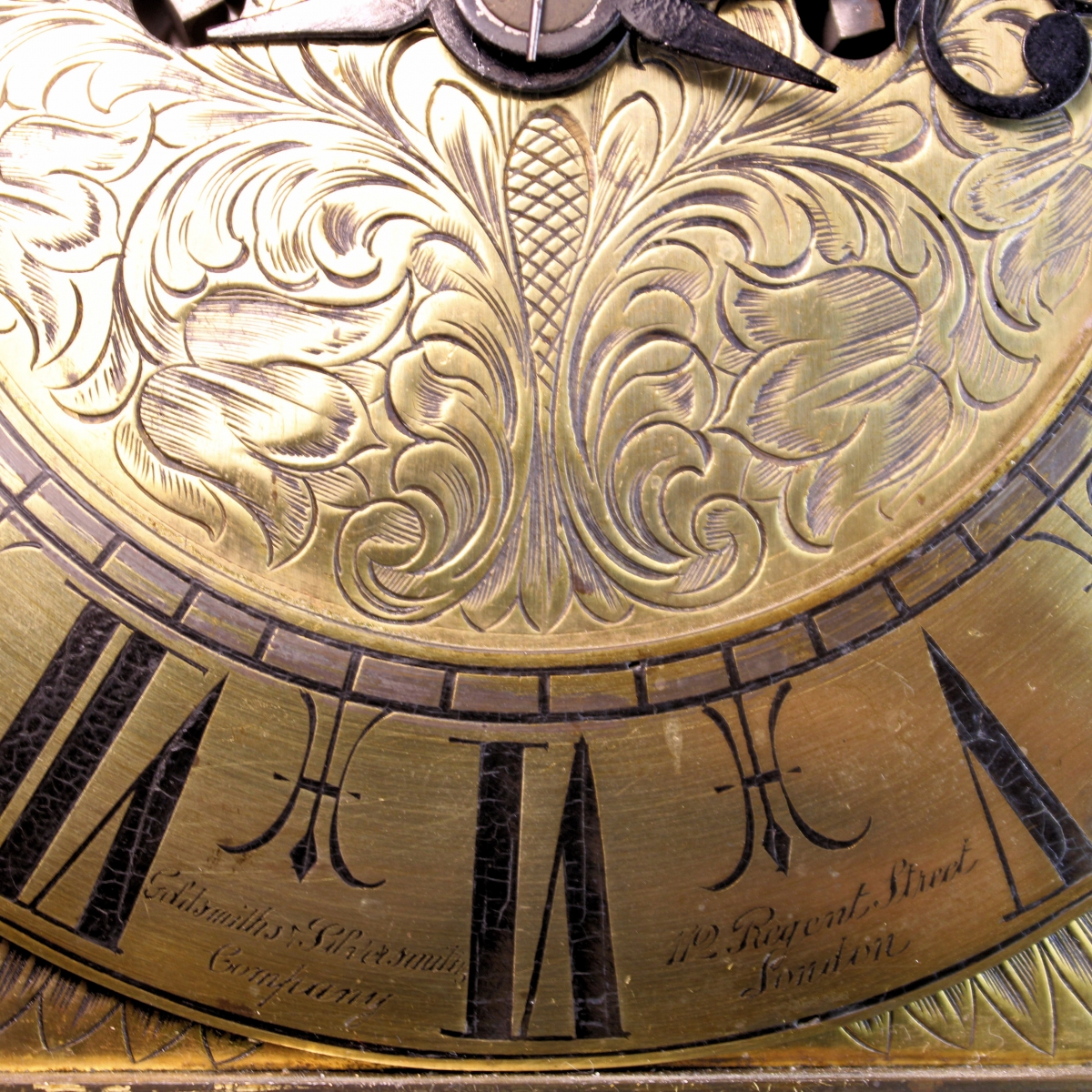
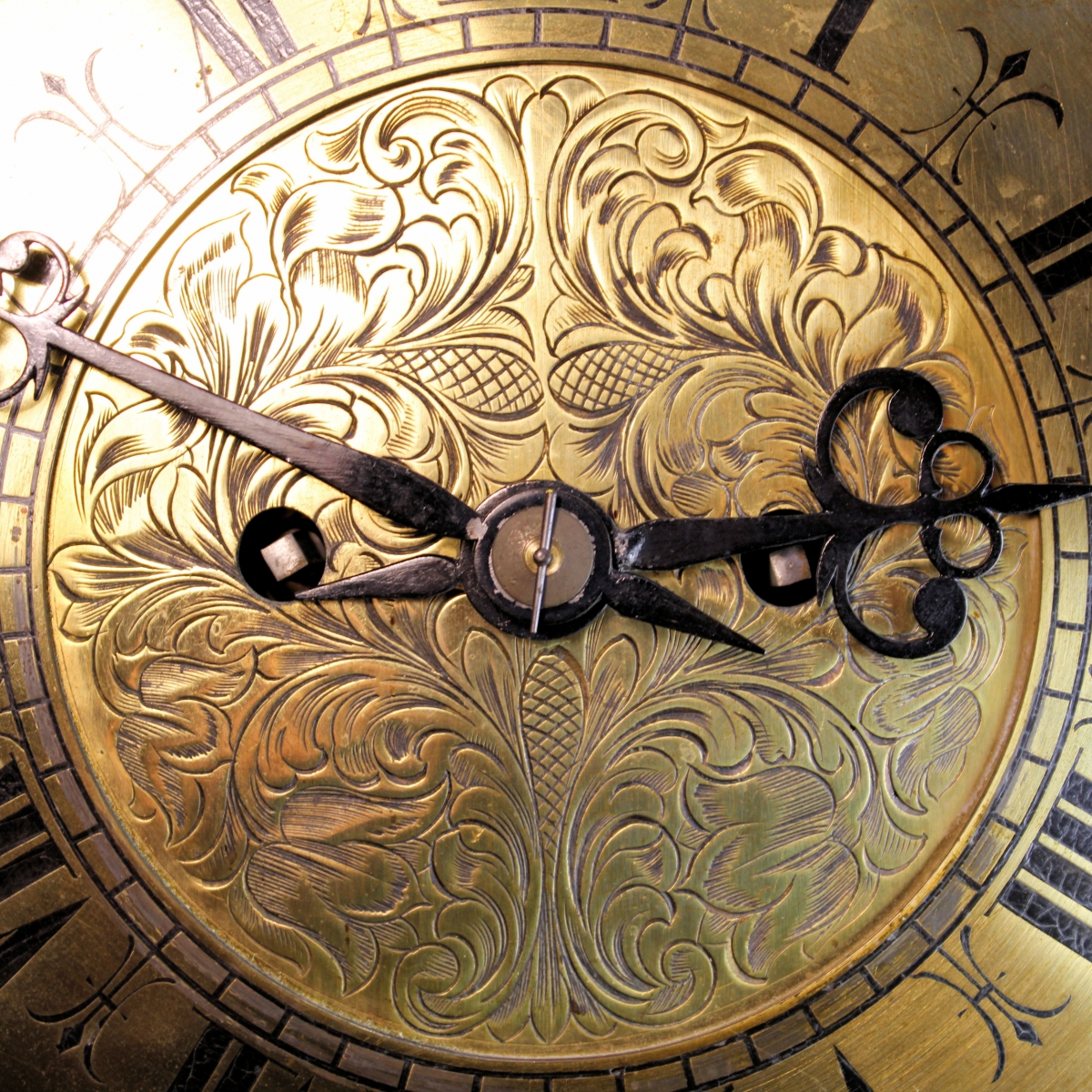
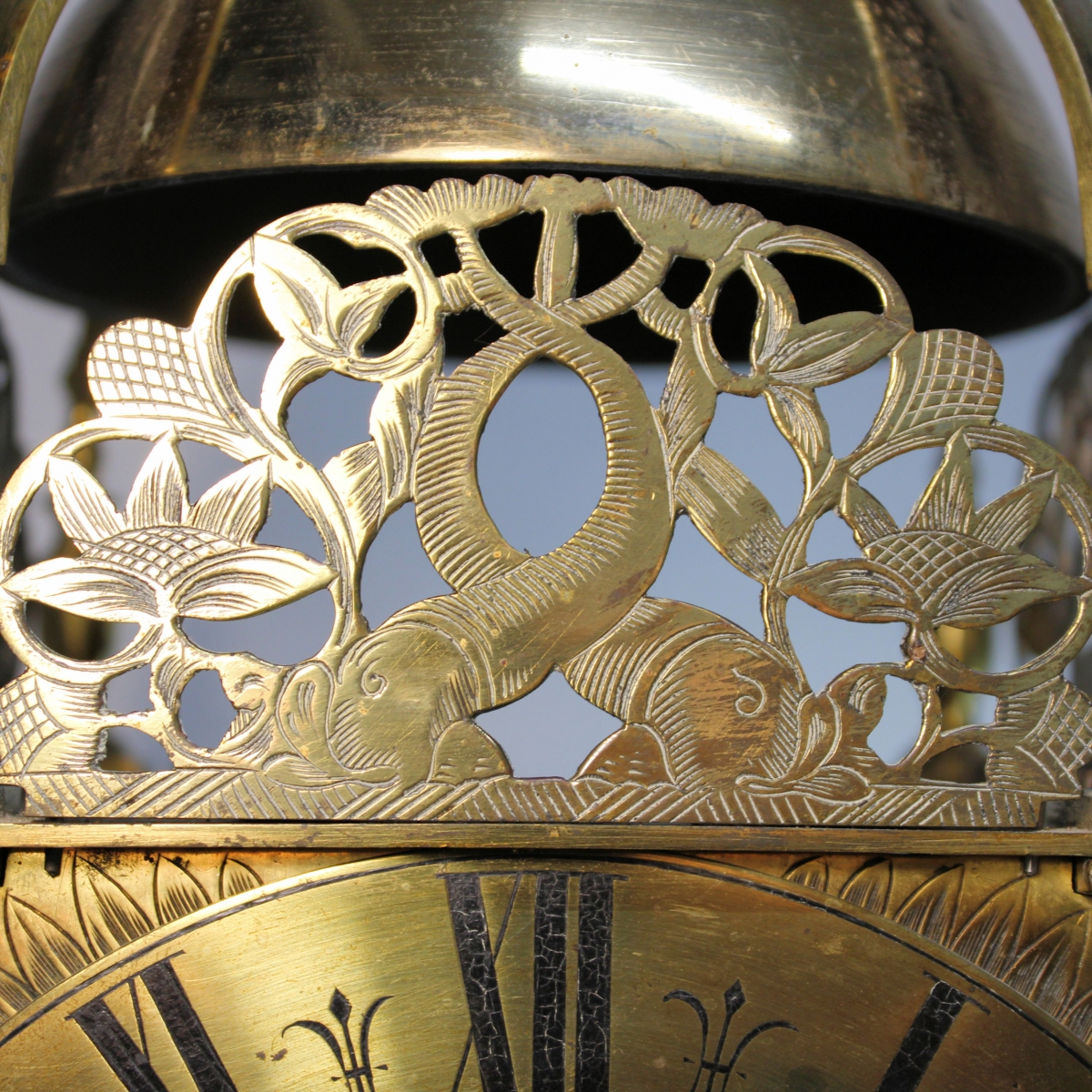
Contained in a very substantial, solid brass, lantern style case with corner pillars, urn capitals and ball feet. The sides and rear have hinged opening doors and the finials carry the bell strap that carries the large brass bell. Between the finials are 3 cast 'Dolphin' style pierced frets the front of which in engraved. The front dial plate is also fully engraved and of tulip style. The 6 1/2" diameter, engraved and wax-filled chapter ring has Roman hour numerals, 1/2 hour markings and an inner, divided 1/4 track. The signature that flanks the numeral VI reads "Goldsmiths & Silversmiths Company, 112 Regent Street, London". The pierced metal hands are matching and blackened.
The clock is screw-fixed to its dark oak base that has a top moulded edge and 4 low block feet.
* The Goldsmiths & Silversmiths Company was a prominent British jeweller, silversmith, and watchmaker that was founded in 1880 at 112 Regent Street, London. It was established by William Gibson and John Lawrence Langman. It traded under this name until 1898 and the firm operated until amalgamating with Garrard & Co in 1952. Operations concluded in 1959.
** These late Victorian clock were extremely popular during the Gothic revival because they did not need to be hung on a wall with weights beneath them, they had a duration of 8 days and also had 2 hands so that time could be read more accurately. Usually, these clocks are original 17th and 18th century examples that have been converted to fusee movement in the 19th century however, this is exactly how this example was made.
Dimensions: 16 3/4" high including the oak base which is 7 1/4" x 7 1/4".
The movement top and bottom plates are 5 3/4" x 5 3/4".
Circa: 1890.
Condition: The movement is historically very well maintained. Due to recent neglect, it would
benefit from a full strip down and clean however, I do not feel that this is
necessary at present and is working perfectly. The case is excellent with a lot of
its original lacquer remaining but there is evidence of metal polish being used on
it. It is tarnished in areas which adds to its charm. The rear of the base plate has
a dent which can be removed and the rear of the wooden base has a small area
that has been cut out - possibly to allow it to go against a household wall with a
wire running up it? All in all, this clock is in exceptional condition and extremely
well made.
Price: £2,650 in present and working condition.
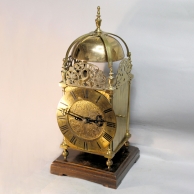
English fusee lantern clock retailed by the Goldsmiths & Silversmiths Company. Circa 1890.
View Details
A rare and small, Georgian, travelling wall clock discribed as a 'Sedan chair clock'. Circa 1790.
View Details