FREQUENTLY ASKED QUESTIONS.
Helpful answers from M. C. Taylor, Master Clockmaker
Mechanical clocks can give reliable service for generations, but they require correct care, periodic maintenance and, when necessary, skilled repair.
Below are answers to the questions most frequently asked by clock owners. If your question is not covered, please telephone the workshop or send us photographs of your clock.
Why has my mechanical clock stopped?
A clock can stop for many reasons. It may be incorrectly positioned, out of beat, obstructed by touching hands or a rubbing pendulum, overdue for servicing, or suffering from mechanical wear.
If a clock repeatedly stops, there is usually an underlying cause. Continually restarting it or adding oil may make matters worse.
A proper examination will establish whether the clock requires a simple adjustment, servicing or more extensive restoration.
Can a mechanical clock be overwound?
A clock that is fully wound but will not run is often described as “overwound.” However, being fully wound is not normally the fault.
The mainspring may still contain power, but dried lubricant, dirt, wear or another mechanical problem may prevent that power from passing through the movement.
Do not attempt to release a wound mainspring yourself. It stores considerable energy and can cause damage or injury if released incorrectly.
Why does my clock run for a few minutes and then stop?
This can happen when a clock is out of beat, the pendulum is rubbing, the hands are touching, or there is insufficient power reaching the escapement because of dirt or wear.
A clock that runs only when tilted may have been positioned incorrectly, but it may also have been adjusted previously to compensate for another fault.
If the clock still stops after checking that the pendulum and hands can move freely, professional examination is advisable.
Why has my clock stopped after being moved?
Pendulum clocks are sensitive to their position. Moving one—even across the same room—can disturb its level, beat, pendulum, suspension or internal setup.
Longcase clocks require particular care because the weights, pendulum and movement must be transported and reinstalled correctly.
Do not continue forcing or repeatedly restarting a clock that has stopped after moving. We can advise on correct setting-up and offer collection and delivery service when required.
Why is the tick-tock uneven?
An uneven rhythm may indicate that the clock is “out of beat.”
Instead of an evenly spaced:
tick—tock—tick—tock
you may hear a slight delay between the tick and tock:
tick……tock—tick……tock
A clock that is badly out of beat may stop. The cause may be its position, movement during transport or a mechanical adjustment that requires professional attention.
Why does my clock gain or lose time?
Minor errors can often be corrected by carefully regulating the pendulum. Raising the pendulum bob generally makes a pendulum clock run faster; lowering it makes the clock run slower.
Make only small adjustments and observe the clock over several days.
Large, inconsistent or continually changing errors may indicate wear, poor setup, contamination, an incorrect pendulum or another fault that cannot be corrected by regulation alone.
Why does my clock strike the wrong hour?
The hands and striking mechanism may have become out of sequence, particularly after the clock has stopped, been moved or had its hands repositioned.
The correct procedure depends on the type and age of the striking mechanism. Moving the hands carelessly or forcing the clock through a striking sequence may cause damage.
If you are unsure, stop and ask for advice before attempting further adjustment.
Why does my clock run but no longer strike or chime?
The timekeeping, striking and chiming functions are often powered by separate trains within the movement. One part of the clock can therefore continue running while another fails.
The cause could be as simple as one train not being wound, but it may also involve wear, obstruction, incorrect adjustment or a fault within the strike or chime mechanism.
Never force a winding key that will not turn.
Which winding hole does what?
This depends on the design of the clock.
On many clocks:
- One winding hole powers the timekeeping train
- A second powers the hour strike
- A third powers the quarter-chime mechanism
The arrangement is not identical on every clock.
Can I damage my clock by winding it incorrectly?
Yes. Possible damage can result from using the wrong key, winding in the wrong direction, forcing a fully wound train, allowing the key to fly backwards or continuing after unusual resistance is felt.
Use a correctly fitting key and support it securely while winding. Wind slowly and steadily, stopping when the mechanism reaches firm resistance.
Should I oil my clock myself?
We do not generally recommend owner-applied oiling.
Mechanical clocks require specialist lubricants applied sparingly to specific points. Household oil, spray lubricants and products such as WD-40 can spread through the movement, attract dust and cause serious long-term damage.
Adding fresh oil to a dirty or worn movement does not constitute a service. It can combine with existing contamination to form an abrasive residue.
How often should a mechanical clock be serviced?
Traditionally, it was every 4 to 5 years however, there is no single interval suitable for every clock now. The appropriate period depends upon the movement, its condition, its environment, the lubricant used and how continuously it runs.
A clock should be examined if:
- It begins stopping or losing power
- Its ticking becomes weak or irregular
- Its timekeeping deteriorates
- The striking becomes hesitant
- Dark residue appears around the pivot holes
- It has not received professional attention for many years
A clock can continue running while damaging itself, so continued operation is not proof that everything is in good condition.
What is the difference between servicing, repair and restoration?
A service is preventive work undertaken on a fundamentally sound movement.
A repair corrects a particular fault or damaged component.
A restoration is more comprehensive. It may involve complete dismantling, cleaning, examination and correction of accumulated wear, damage, alterations or poor previous work.
The correct treatment can only be recommended after the clock has been properly examined.
What does a proper clock restoration involve?
The precise work depends on the clock, but restoration may include:
- Careful dismantling of the movement
- Cleaning each component
- Examining wheels, pinions, pivots, bearings and springs
- Correcting wear and mechanical faults
- Repairing or making missing components
- Correcting the escapement
- Repairing the strike or chime mechanism
- Reassembling and lubricating correctly
- Regulating and testing the clock over an extended period
- Conserving the dial, hands or case where required
The objective is to correct the causes of failure while preserving originality wherever possible.
Will restoration make my antique clock look new?
Not unless inappropriate work is undertaken.
A good restoration respects the clock’s age, history and character. Original finishes, patination and evidence of traditional craftsmanship should be preserved wherever possible.
The aim is to return the clock to sound and reliable condition—not to erase its age or make an antique appear newly manufactured.
Will restoration increase the value of my clock?
Appropriate restoration can make a clock usable, presentable and more attractive to a future buyer. However, excessive refinishing, replacement of original components or historically insensitive work can reduce its value.
The effect depends upon the clock’s quality, rarity, originality and condition before the work begins.
For an important clock, conservation decisions should be made before any work is undertaken.
Is my clock worth repairing?
Financial value is only one consideration.
Some clocks justify restoration because of their quality, rarity or importance. Others have modest market value but enormous sentimental significance to their owners.
Before proceeding, you should understand:
- What the clock is
- What appears to be wrong
- What work is necessary
- The likely cost
- Its approximate financial value
- Whether less extensive treatment would be appropriate
M. C. Taylor will give you an honest assessment so that you can make an informed decision.
Why can clock restoration be expensive?
A mechanical clock may contain hundreds of interacting components. Proper restoration requires specialist knowledge, equipment and many hours of skilled work.
Replacement parts for antique clocks are rarely available ready-made. Worn, broken or missing pieces may need to be repaired or individually manufactured.
The visible fault may be only a symptom. The movement must often be dismantled to reveal and correct the underlying wear that caused it.
Can you tell me the repair cost from a photograph?
Photographs can help identify a clock and reveal obvious damage, but they cannot show all the wear inside a movement.
An initial opinion may be possible from good photographs and a clear description of the symptoms. A reliable restoration estimate normally requires physical examination.
What photographs should I send?
Please include:
- A full view of the clock
- A clear photograph of the dial
- The maker’s name or any inscription
- The back and sides of the case
- The movement, but only if it is safely accessible
- Any visible damage or missing components
- Labels, numbers or marks
- The pendulum, weights and key
Never dismantle a clock or move a heavy longcase clock simply to obtain a photograph.
Do you repair all types of mechanical clocks?
M. C. Taylor specialises in antique and quality mechanical clocks, including:
- Longcase and grandfather clocks
- Mantel and bracket clocks
- Wall and dial clocks
- Carriage clocks
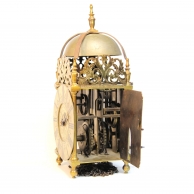
- Lantern clocks
- French clocks
- Fusee clocks
- Striking and chiming clocks
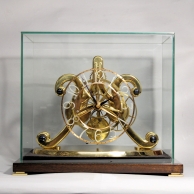
- Skeleton clocks
- Other unusual or complicated mechanical timepieces
Please contact us with photographs if you are unsure whether your clock is suitable.
Do you repair battery and quartz clocks?
Our principal specialism is antique and mechanical clockwork.
Can you collect and deliver my clock?
A collection and delivery service is available, depending upon the clock and location.
This can be especially useful for longcase clocks and other large or delicate timepieces that require careful dismantling, transportation and setting up.
Please telephone or email to discuss the clock, its location and access arrangements.
Should I use an ordinary removal company to move a longcase clock?
A longcase clock should be prepared before transportation. The weights and pendulum must be removed, moving parts secured and vulnerable components protected.
Incorrect handling can damage the suspension, lines, pulleys, dial, movement and case.
If possible, use someone who understands how longcase clocks should be dismantled, transported and recommissioned.
Can you identify and value my clock?
Yes.
M. C. Taylor provides specialist clock and barometer valuations. A valuation may include:
- Identification
- Approximate date and country of origin
- Information about the maker
- Comments on quality and authenticity
- Relevant alterations or unusual features
- Insurance, probate or selling value, as requested
Online valuations are available from photographs, or a physical examination can be arranged where appropriate.
What is the difference between insurance, probate and selling value?
An insurance valuation generally reflects the reasonable cost of replacing the clock with a comparable example following loss or serious damage.
A probate valuation normally reflects the amount the item might realise if sold at the relevant date, often under estate-sale conditions.
A selling value considers what the owner might realistically receive through an appropriate method of sale.
These figures can differ considerably because they answer different questions.
Can you tell whether my clock is genuine and original?
A Master Clockmaker examines the relationship between the movement, dial and case, together with construction, materials, style, signatures and evidence of alteration.
Many antique clocks have been repaired or altered during their lives. Some changes are historically understandable; others can materially affect authenticity and value.
A confident conclusion may require physical examination, particularly when important components cannot be assessed from photographs.
Can you advise me before I buy an antique clock?
Yes.
Independent advice can help establish whether a clock appears correctly described, substantially original and reasonably priced. It may also reveal restoration requirements or alterations that are not obvious to an inexperienced buyer.
Please seek advice before committing to the purchase, particularly when the clock is expensive or historically important.
Can you help me sell a clock?
We can advise on identification, realistic value and the most appropriate method of sale.
The best route may depend upon the clock’s quality, condition, value, size and likely market. Private sale, specialist dealership and auction each have different advantages and costs.
Please send photographs and relevant details for an initial assessment.
Do you buy antique clocks?
We may be interested in purchasing selected antique clocks, depending upon their type, quality, originality, condition and current demand.
Please send clear photographs and state whether the clock is working, what is known about its history and where it is located.
We cannot guarantee that every clock offered will be suitable for purchase.
Why should I take my clock to M. C. Taylor?
Mark Taylor has specialised in mechanical clocks and barometers since establishing his Bournemouth Clockshop in 1987.
Your clock will receive:
- An informed examination
- Honest advice before work begins
- Respect for its originality and history
- Traditional clockmaking skills
- Careful restoration rather than a temporary remedy
- Proper adjustment and testing
- A personal and accountable service
Whether your clock is financially valuable or simply precious to your family, it deserves careful and knowledgeable attention.
Do You Have a Question About Your Clock? Please telephone the workshop or send us photographs with a short description of the problem.
M. C. Taylor — The Master Clockmaker
Established 1987
Antique Clock and Barometer
Repairs • Restoration • Valuations • Authentication • Sales • Advice
995 Christchurch Road
Bournemouth, Dorset BH7 6BB
Telephone: 01202 429718
Email: info@bournemouthclocks.co.uk
Website: www.bournemouthclocks.co.uk
Please telephone before bringing a large, fragile or difficult-to-move clock to the workshop.
_________________________________________________________________________

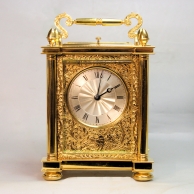
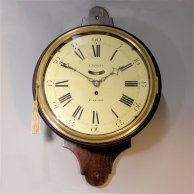
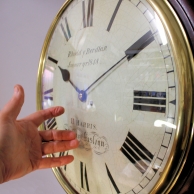
A 'Salt box' verge escapement, fusee, English dial wall clock by Upjohn of Exeter. Circa 1790.
View Details