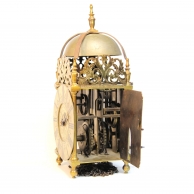
English lantern clock attributed to James Ogden senior of Soyland, West Yorkshire. Circa, late 17th century.
An initialed example of a lantern clock by this highly collected maker.
Stock No: 14527
An absolutely typical style of lantern clock made by this family of Clockmakers.
The 30 hour duration movement converted from Verge to Anchor Recoil escapement and long pendulum. Countwheel striking the hours on a large top-mounted cast bell that is hung from a sprung, attractive, crossed bell strap with an ornate centre and set within the 4 top finials.
The 6 1/8" diameter engraved chapter ring has an outer ring, Roman hour numerals, an inner, divided quarter track and Fleur-de-Lys half hour marks. This is riveted onto the dial plate at XII, III, VI and IX. The dial plate has tulip engraved corners and the centre is heavily and boldly engraved with tulip design with large open tulip within a circular rosette. The one-piece cut and tailed, blackened steel hand is of a pleasing and practical style. As usual, the trains are set in front and behind one another within 3 upright supporting plates with the front and back ones being of cruciform style. It retains its original sprockets but these have been modified for chain.
The 4 corner frame pillars terminate with ball feet and urn finials. The top plate carries 3 cast foliate style frets the front of which is engraved and initialed.
* James Ogden senior was father to 4 clockmaking brothers in Soyland, near Halifax in West Yorkshire. He was born in the 1640's and died in 1735. This clock is featured in Loomes' book 'Clockmakers of Britain 1286-1700. Pages 323 and 324. The frugal use of brass in this clock definitely indicates that is it Quaker made as Quakers were against waste and always strove to provide good 'value for money' also, as Loomes states - the lack of a signature and simply bearing the initials "JO" to the front fret is also a sign of modesty.
Dimensions: 12 1/4" high (due to the broken top finial) x 5 1/2" wide x 5 1/2" deep excluding
the chapter ring and back cock.
Circa: 1680.
Condition: The case is polished and lacquered but the movement is dusty and dirty. The
side doors, iron backplate, hoop, spikes, pendulum, weight and top finial are
missing, probably due to a historic fall from the wall (it is estimated that 99% of
English lantern clocks have fallen from the wall). The escapement has been
converted for greater accuracy from Verge to long pendulum Anchor Recoil and
the going train has 2 replaced pinions. Prolonged use throughout its life is
evident. The hammer strap has a notch to prevent it hitting the shaped pallet
arbor and 6 top screws have been replaced. Following extensive examination by
me the movement appears that with a simple clean, lubrication and
reinstatement of the pendulum and weight, it will be in working order.
Please note: Though the hoop and spikes are missing, the movement can be run if placed on
one of our handmade lantern clock brackets, this is also much gentler on the
clock as it removes all angular strain. The brackets are made from period English
oak and are constructed without nails or screws. Please click this link.
Price: £5,500 in its present condition. We can of course, undertake any
corrective work required by the purchaser and would be happy to discuss this
with you.


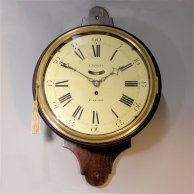
A 'Salt box' verge escapement, fusee, English dial wall clock by Upjohn of Exeter. Circa 1790.
View Details